Kerala mural painting is the wall-painting tradition of temples, palaces and, later, churches across Kerala and the old Travancore country. It is fresco-secco work: pigment laid onto lime plaster that has already set, bound with plant gum, outlined in soot black, and built up over weeks in a fixed order that has barely changed in four centuries.
Most people meet it first as decoration — a Krishna on a hotel wall, a Ganesha printed on a saree border. What that misses is that the tradition is a codified system. The proportions, the colours, the gestures and even the shape of an eye are prescribed by texts. An artist working in this style is not inventing a figure. They are rendering one correctly.
Kerala mural painting explained through its five colours, natural pigments, traditional stages, symbolism, and the techniques behind this art form
Where the tradition comes from
Wall painting in Kerala goes back much further than the murals most visitors see. Early rock-shelter and cave-temple paintings survive from around the ninth to twelfth centuries. But the tradition as it is recognised today — the dense, ornament-heavy, jewel-coloured style — flourished between roughly the sixteenth and nineteenth centuries under temple and royal patronage.
The rules come from Sanskrit treatises. The Shilparatna, compiled by Srikumara in the sixteenth century, sets out pigment preparation, wall preparation and the proportions of figures. The Tantrasamuchaya governs how deities may be shown. Alongside these sit the dhyanaslokas, meditation verses that describe each deity in precise visual terms.
This matters for anyone learning the art form. The artist begins from the verse, not from imagination. The mural does not illustrate a story so much as present the deity as the verse describes — so that the wall becomes a place to look at rather than a picture to read.
Where you can still see the originals
Reproductions are everywhere; original walls are not. If you want to understand the scale and the surface, these are worth planning a trip around.
- Mattancherry Palace, Kochi holds the best-known cycle, with Ramayana panels covering the bedchamber walls in extraordinary density.
- Padmanabhapuram Palace, the old Travancore capital, sits just over the Tamil Nadu border but is still administered by Kerala.
- Krishnapuram Palace, Kayamkulam is home to the Gajendra Moksham panel, among the largest single mural compositions in Kerala.
- Ettumanoor Mahadeva Temple has the Nataraja mural on the outer wall of the sanctum — a figure most serious students study before attempting their own.
- Vadakkumnathan Temple, Thrissur and Thodeekkalam Temple, Kannur are older, quieter and less restored.
Photography is restricted at most of these sites, and parts of several temples are closed to non-Hindus. Check before you travel.
The panchavarna system: colour as classification
The five colours — yellow, red, green, black and white — are not chosen for how they look together. Colour tells you what kind of being you are looking at, borrowing the three-guna classification from Indian philosophy.
- Green marks sattvic figures: balanced, serene, divine. Rama, Krishna and Vishnu are green.
- Red and gold mark rajasic figures — kings, warriors, beings driven by ambition and appetite.
- Black and white mark tamasic figures: demons, fierce forms, the wrathful aspects of goddesses.
This is why a beginner who paints Krishna in blue has made a real error rather than a stylistic choice. In Kerala mural convention, Krishna is green. The classification is the point, and the same logic runs through Kathakali make-up, which is why the two art forms look related.
The five pigments and where they come from
Manayola (yellow) comes from ochre stone, ground on a slab and washed repeatedly until only the finest particles remain. It carries skin tones for many divine and heroic figures, gold ornament, and the base wash that warms the whole surface.
Chuvappu (red) comes from laterite soil and from chenchilyam, the mineral that gives the tradition its deepest, most saturated tone. It is used for rajasic figures, backgrounds, borders and ornament.
Pacha (green) is prepared from the eravikkara leaf over several days, sometimes extended with indigo to shift the tone. It belongs to the sattvic figures.
Neelam (blue) comes from neelamari, the indigo plant, fermented and dried into cake before grinding. It is used sparingly on its own — mostly mixed to deepen green, and for water, night and certain garments.
Karuppu (black) is soot collected from an oil lamp burned under a clay plate. It is the slowest and cheapest of the five to make, and the one everything else depends on, because the whole composition is held together by black line.
The binder is gum from the neem tree, thinned with tender coconut water. Brushes are made from grass roots for fine line work and from animal hair for filling. The wall itself is prepared with several coats of lime plaster mixed with fine sand.
Almost no one working today grinds all their own colour. Most artists use acrylic or poster colour on canvas, matched to the traditional palette. Purists disagree about this, and both positions are reasonable — but if you are learning, know that pigment preparation is a separate discipline from drawing. You do not need to master both at once.
- Kerala Mural Painting: The Five Colours, the Meaning Behind Them, and How It's Made — Kerala mural painting is the wall-painting tradition of temples, palaces and, later, churches across Kerala and the old Travancore country.
- Where the tradition comes from — Wall painting in Kerala goes back much further than the murals most visitors see.
- Where you can still see the originals — Reproductions are everywhere; original walls are not.
- The panchavarna system: colour as classification — The five colours — yellow, red, green, black and white — are not chosen for how they look together.
- The five pigments and where they come from — Manayola (yellow) comes from ochre stone, ground on a slab and washed repeatedly until only the finest particles remain.
The five stages of painting a mural
The sequence is fixed. Skipping ahead is the single most common reason a beginner's painting looks wrong without their being able to say why.
- Lekhya Karma — the sketch. Light, correctable, establishing proportion and placement across the whole surface before any single figure is resolved.
- Rekha Karma — the outline. The drawing is firmed up. Line quality is decided here, and it is the confident, unbroken contour that gives mural figures their weight.
- Varna Karma — flat colour. Colour is laid in, lightest first, working through the palette in order. No shading yet.
- Vartana Karma — toning. Depth is built with layered washes rather than with light-and-shadow as a Western painter would understand it.
- Lekha Karma — final line and detail. The last black outline, then eyes, ornament and hair. This is the stage that makes a painting look finished, and the stage that takes longest.
From temple wall to canvas, saree and church
By the early twentieth century the tradition was close to disappearing. Its revival is credited largely to Mammiyoor Krishnankutty Nair, whose work led to the founding of a dedicated mural painting institute at Guruvayur in 1989. Formal training also runs through Sree Sankaracharya University of Sanskrit at Kalady, and through a wide network of independent studios across Kerala.
What has changed since then is where the murals live. The same iconography and the same five-stage method now appear on stretched canvas, on wooden panels, on kasavu sarees hand-painted along the border and pallu, on wedding invitations, and on the walls of Syro-Malabar and Orthodox churches, where Christian subjects are rendered in a wholly Kerala visual language. A mural-style Nativity or Last Supper is now a recognised commission in its own right.
This portability is why the art form travels well. A canvas mural fits in a suitcase; a wall does not. It is also why the tradition now has students in Houston, London, Dublin, Toronto and Melbourne as well as in Thrissur.
Learning Kerala mural painting today
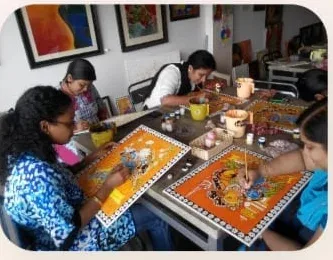
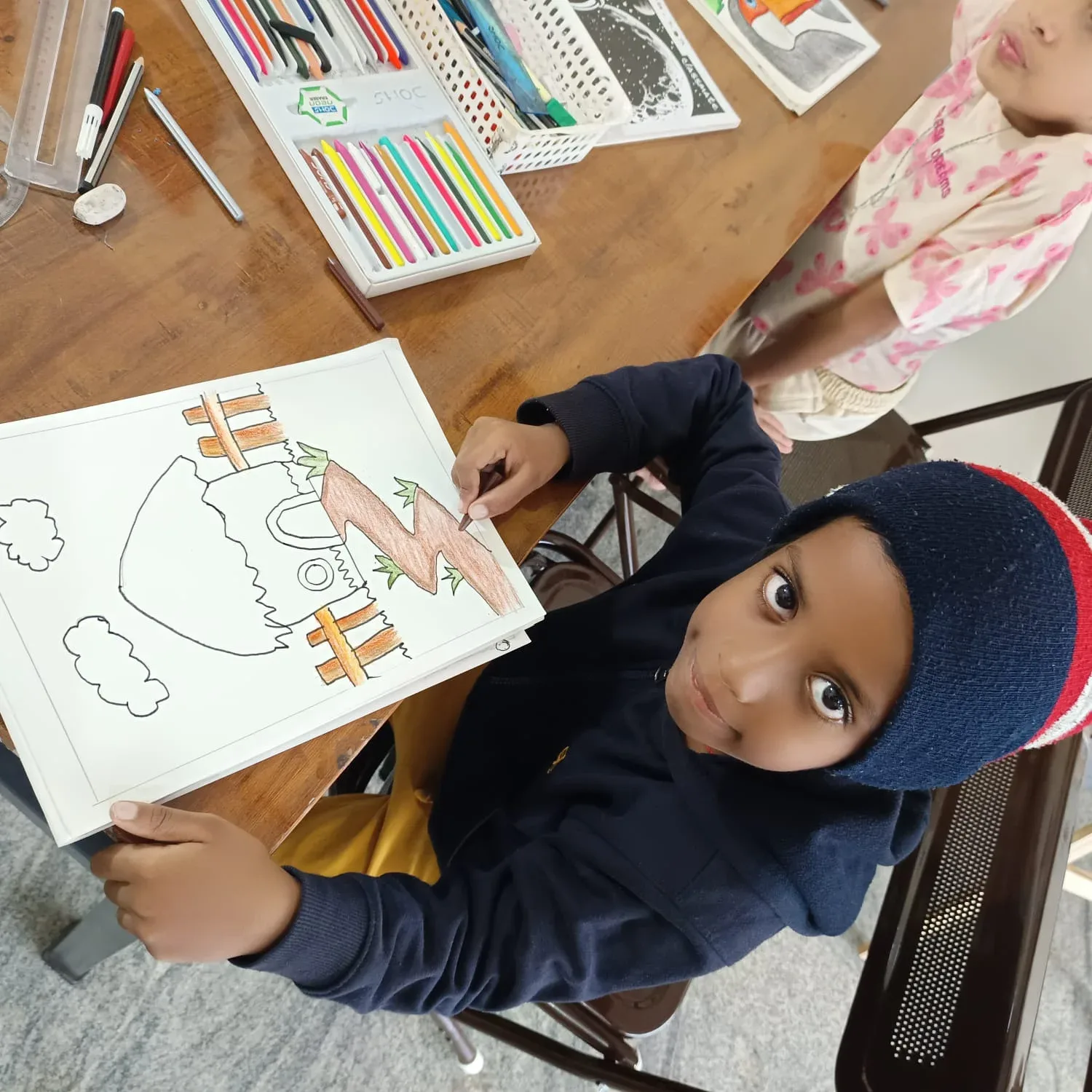
The honest answer is that this art form is learned through repetition of a small number of standard exercises before anyone lets you near a full composition. Expect to spend real time on line drills, on the eye, and on hand gestures, traced and re-traced until the proportion sits in your hand rather than in your measuring.
That structure is also what makes it teachable remotely. The exercises are the same whether the teacher is in the room or on a screen, and a beginner working from printed outlines is doing exactly what a beginner in a Kerala studio does. Tracing is part of the traditional method, not a shortcut around it.
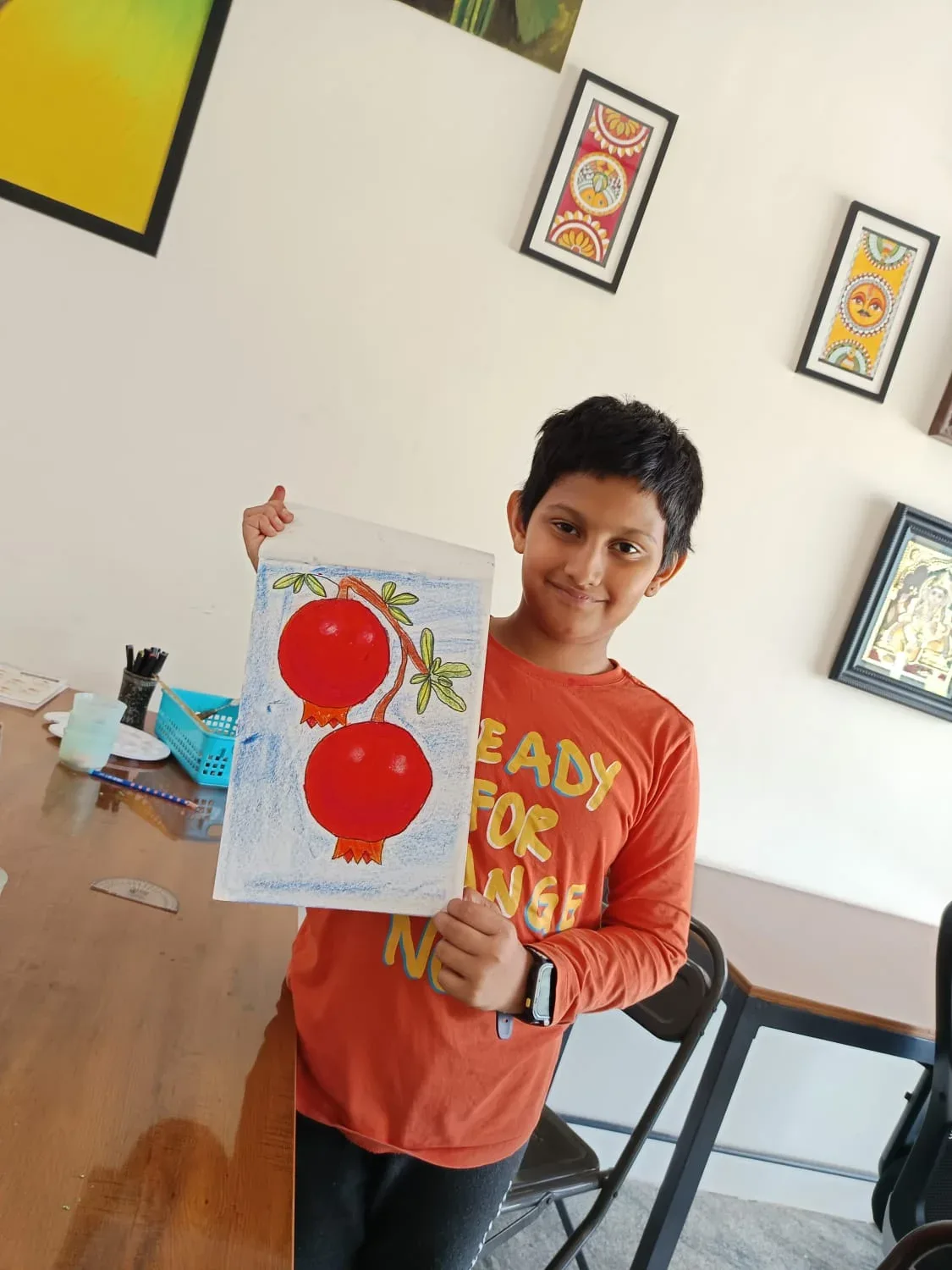
A reasonable first eight weeks looks like this: two weeks on line and border motifs, two weeks on the mural eye and face, two weeks on a simple seated figure such as Ganesha, and two weeks on your first full colour piece. After that, the subject you choose starts to matter more than the drills.
Common questions
What are the five colours in Kerala mural painting?
Yellow, red, green, black and white — the panchavarna. Traditionally prepared from ochre stone, laterite and chenchilyam, the eravikkara leaf, lamp soot, and lime. Indigo from the neelamari plant is used alongside them, mainly mixed to extend the green.
Why is Krishna painted green rather than blue?
Kerala mural convention classifies figures by temperament. Serene, balanced, divine figures — Rama, Krishna, Vishnu — are green. Ambitious or worldly figures are red. Fierce figures are black or white. The colour identifies the character type, so green is correct within this tradition even though Krishna appears blue elsewhere in Indian art.
Can a complete beginner learn Kerala mural painting?
Yes. The tradition is taught through a fixed set of drawing exercises, so no previous painting experience is assumed. Most beginners spend their first few weeks on line control, the eye, and simple ornament before painting a full figure.
How long does it take to paint a mural?
A small canvas figure takes a beginner around eight to fifteen hours spread across several sessions, because each layer must dry before the next. Detailed temple wall work runs to months and is usually done by a team.
Do I need traditional natural pigments?
No. Most artists today work in acrylic or poster colour on canvas, matched to the traditional palette. Preparing natural pigment is a separate discipline worth learning later if you want to work on plaster.
Can I learn Kerala mural painting online from outside India?
Yes. Because the syllabus is exercise-based and works from printed outlines, it translates well to live video classes. Look for batches timed to your region and check whether the material kit ships to your country before you book.